PATRICIA FRISCHER, the coordinator of the San Diego Visual Arts Network, writes these occasional notes. You are invited to comment on them and all comments will be read. SDVAN has the ability to choose which comments to publish and anonymous comments will not be posted nor will links to commercial or spam sites. We are grateful to you for taking the time to read this blog and invite you join this mailing list or that of www.sdvisualarts.net
The
art film ARTWithout Borderscelebrates Patricia Frischer, SDVAN, and
the San Diego Art Prize and was created by Mark Murphy . Please
share this link to spread the word about the work we are doing.
Art Without Borders: Visionary Artists from San Diego & Baja
Norte
This short film features San
Diego art advocate Patricia Frischer, founder of the San Diego Visual Arts
Network and the San Diego Art Prize. You will enjoy an inspired tour
of the artists behind the San Diego Art Prize and a binational community of
artists who transcend borders through creative expression, mentorship, and
cultural dialogue.
From emerging voices to seasoned visionaries, the film
showcases the impact of artistic collaboration, identity exploration, and
community building in a region where art serves as both a social force and a
bridge between cultures.
🔗SDVAN is dedicated to
fostering an inclusive and dynamic visual arts community by valuing artists,
engaging the public, and using art as an economic driver. The organization
emphasizes mentorship, education, and collaboration to reduce barriers to art
appreciation and participation.
By providing free access to its resources and
promoting diverse voices, SDVAN ensures that the visual arts are a vital and
accessible part of San Diego’s cultural life https://www.sdvisualarts.net
SDVAN
was founded by Patricia Frischer, who has orchestrated San Diego’s most
significant online hub for visual arts, connecting over 1,500 artists and 1,000
organizations. Through mentorship, collaboration, and free resources, SDVAN
strengthens the arts community while making creativity accessible through art
events, education, and community empowerment.
🏆 About
the SDART Prize: The SDART Prize celebrates artistic excellence by awarding cash
prizes and providing prestigious exhibition opportunities. This initiative
highlights the creative talent that fuels our region’s vibrant cultural life.
🌟 Why SDVAN Matters: Largest
visual arts directory in San Diego 🌴 Free access to art services, management, and educational
resources 📚 Promotes
diversity, inclusion, and cross-border collaboration 🌎 Drives regional economic growth
through the power of art 💥
Robert Friedman at the Mission Fed ArtWalk celebration for featured artists at ArtReach new headquarters in Hillcrest.
Robert Friedmanis the recipient of this year’s Business of Art Scholarship and will have booth #344 on Cedar Street at theMission Fed ArtWalkon Sat/Sun April 26/27. San Diego Visual Arts Network is the sponsor of this scholarship and is proud to see how the artist’s subjects fits into theHealing, Health and Hopetheme of theApril Arts, Culture and Creativity Monthcelebrations.
Robert Friedman has experienced the highs and lows of life during his travels and work as a humanitarian. He has connected with refugees and victims of disaster and war. He views the world with awe at times, but also with heartbreak and concern. He studied visual arts as an undergraduate, but even as a teenager, he found his medium in photography. “Do I capture an image or does the image capture me?” is his explanation of his storytelling quest on view in his Lifescapes.
Sandi Cottrell and her sister Judy Berman Silbert
Judy Berman Silbert and her sister Sandi Cottrell were lucky to have art in their lives from an early stage. But we all know 2007 brought massive cuts in the arts in public schools. Sandi was Managing Director of ArtWalk San Diego when I met her and Judy, who was already working with elementary school art programs brought the new experience of ArtReach to ArtWalk. In fact, it was an ArtWalk artist, Patti Fox who helped design the pilot project. Right away this new programs was launched into a free program starting at Garfield Elementary.
At that time, San Diego Visual Arts Network was supplying a hands on live art experience at ArtWalk as well as the Business of Art Scholarship. The two came together at the celebration of this year’s featured artists including Robert Friedman, the Business of art Scholarship recipient for 2025. This lovely event was held at the new offices of Art Reach in Hillcrest.
The party celebration at ArtReach Headquarters
Two Videos of the ArtReach event and workshop spaces
ArtReach believes that young students can create original art. They should be encouraged to express themselves and be as creative as possible. Of course, they need guidance, but that is supplied by professional working artist.
From summer camps to birthday parties, in-school and after school, since 2007, ArtReach has provided over 86,000 young people with life-changing opportunities to create original art.
Party ARTy for ArtReach on June 8 from 3 – 6 pm Anna Laroque 619-940-7278 An inspiring afternoon of creativity, community, and connection to support free visual arts education for San Diego County youth. Set in a stunning Del Mar home, this party will feature: Hands on art-making with ArtReach artists, A student art showcase celebrating young creatives, Toss a Ring for a chance to take home a bottle of fine wine A thoughtful menu featuring appetizers, salad and a choice of three paellas Live and silent auctions with exclusive experiences and unique items Your attendance on June 8th helps ensure that all children, regardless of economic circumstance, have access to art making. For tickets starting from $175.
As the founder and coordinator of the San Diego Visual Arts Network (SDVAN) and as a working artist, I want to share our revised Mission, Vision, Core Value and Commitment with you.
Mission
The San Diego Visual Arts Network (SDVAN) is committed to connecting and
promoting visual artists with organizations and the public to create a vibrant,
collaborative art ecosystem across San Diego County. We are dedicated to
celebrating creativity, amplifying the diversity of voices, and enhancing access to
the arts for all.
Vision
We envision a thriving, inclusive, and dynamic San Diego visual arts community
that values artists, engages the public, and uses art as an economic driver
while enriching the lives of its residents.
Core Values
The
visual artist is centralto our
mission.
Mentorship:
Legacy building can only be achieved generation to
generation
Education:
We foster art education as a tool for empowerment and lifelong learning
for artist as well as enthusiast.
Recognition:
Mapping is one way we can identify all the
participants in our cultural ecosystem. Awards, exhibitions, reports help
us recognize excellence.
Collaboration:
We cultivate meaningful connections among artists, galleries, museums,
community groups, and local government. An infrastructure of spokespersons
is our strength.
Inclusion:
There is a type ofartist for every
sort of appreciator. Artist should not have to pay to display. There is a balance of genre, ethnicity, age and even mediums in our programs.
Accessibility:
We are committed to reducing barriers to art appreciation and
participation.
Commitments
Artist
Advocacy: We will advocate for additional funding,
organized visibility, and
opportunities for local artists.
Community
Dialogue: We nurture relationships between artists
and the public through events, workshops, exhibitions, blogs, social media
and community partnerships.
Cultural
Preservation: We will honor San Diego’s diverse
cultural heritage and shine light on underrepresented visual artists.
Digital
Presence: We continue to develop an accessible
online platform for connecting, promoting, and discovering San Diego’s
visual arts community.
Join us in building a stronger arts community! Whether you’re an artist,
curator, collector, administrator or art enthusiast, there’s a place for you in
the San Diego Visual Arts Network. Together, we can shape San Diego into a
world class visual art destination.
SD Art Prize 2024, Gabriel Boils, Francisco Eme, Marisol Rendon.
Anne Mudge's sculpture installation in County Admin building
A recent survey was done with art professionals and artists
who have been involved with public art projects for the County of San Diego by
our County Commission for Arts and Culture. The result of that survey were made
public as is in keeping with all work of the commission. What follows is my
brief summary of that document.
The survey ended with the goal of a public art program. But
I am choosing to put that first:
Celebrate
community and local artistsby putting
art in public spaces within the community which expands access to the arts. Public
Art inspires, educates, and creates an interesting, beautiful experience for
people.
To welcome visitors to the project sites to show what makes us a world class city.
Centralize administration of a public art program under the Arts and Culture Program and standardize the implementation of the ordinance to meet national best practices i.e. a facilitation between government and art.
To tell the story of San Diego County and to show the diversity of artists in both rural and city sites.
·
·Let then go to what works well with the County of San
Diego’s public art process:
The reinstatement of the County Art Commission is viewed as
a great development with the engagement of the Commission’s Public Art
Committee now involved with each project. When qualified professional public art project
management collaborate with the County facilities director and
contractors/inspectors who have experience with art installations, the projects
go more smoothly.
Now, what doesn’t
work well with the County public art process?
The
0.5% allocation for public art is seen as low and has not increased over time,
making it challenging to have the desired impact.
.The County's artist agreement is problematic for artists, as it takes away their copyrights and ownership, and the language needs to be revised to better support both the artists and the County.
There
is a need for clear and transparent guidelines and SOP applicable to all
projects.
Consistent
community input in the selection and discussion process does not always happen.
Finally, what are the
recommendations and challenges to
improve the County public art process to make it more efficient, inclusive, or
impactful for artists, communities, and other stakeholders?
The
0.5% allocation for public art should be increased to 1%.
The
feedback suggests that providing mentorship or consulting support for artists
who have not created public sculpture before would be beneficial. Allowing data
on why work was rejected will help to improve future submissions.
Updating
the current county public art ordinance to reflect national standards by adopting
policies and guidelines for various aspects of the public art program. For
example: simplifying the language in RFPs to be more artist-friendly and
building insurance needs into the budget to support artists.
Increasing
the involvement and reporting to the County Art Commission, with the qualified
public art consultants working as partners.
Allowing
artists to retain copywrite of their own and be able promote that artwork
Publishing
an art inventory and a comprehensive art policy booklet outlining best
practices and clarity would benefit all parties.
Centralizing
the implementation and administration of the ordinance with a qualified public
art professional as an employer of the department.
Standardizing
the system for public input and making sure it is presented in multiple
languages.
The recommendations emphasize the need for a more inclusive
approach to public art installations. Many of the above recommendation would
move to a more equitable systems for less experienced artists as well.
We are so pleased to announce 4 large artists commissioned project in the county:
The City of Escondido's Public Art Commission is seeking qualified artists or teams for theGrand Avenue Art Project, focusing on large-scale art piece to be placed in the roundabout, currently under construction, on Grand Avenue and Broadway. Submissions are due Feb 28 but questions due by Feb 3. The commission fee is $350,00 plus $100,000 for companion pieces
The County of San Diego Animal Care Shelter is making acall for artists for commissions of artwork or purchases. In a variety of mediums from $500 to $50,000
for a new 20K square foot shelter in Santee. There is one large outside sculpture and
7 walls of art needed.Applications are due March 3. More info: Leah Goodwin.
The City of San Dieg is making a call for artist for the Ward Canyon Park Public Art Project.An artist or artist team is sought to design, fabricate and transport permanent, site-specific
artwork for the park improvements and consult during installation of artwork with a budget
of $110,000. The Deadline forapplications is Feb 11.
TheImperial Beach Arts Bureau is making a call for South Bay artists to for a Tourist Destination Marker in Imperial Beach. Installation in 2026/2027 at the end of the IB Estuary on Seacoast Blvd. they want a sign, plaque or any other standing concept that invites people to pose and take photos not to exceed 6' wide x 6' long x 9' tall. For more info:ibartsbureau2@gmail.com
The most interesting part of this presentation was made by Priscilla
Quiroz fromShaw Yoder Antwih Schmelzer & Lange, the advocacy,
public affairs and association management firm in Sacramento. Yes, this is a
lobbying firm. She was the only
one that actually addressed the topic. She pointed out that the democrats still
have a super majority in both the CA Senate and Assembly. There are now more
women than ever (58) and coming close to
a majority (61 men) in the senate, and there are lots of new members as during
this election some of the older members retired or decided to try for higher
offices. There is a feeling that a more
moderate approach will be forthcoming and this conclusion is based on the bills
that passed and were defeated.
Governor Newson has set aside $25M for the department of
justice to fight a variety of national law suits against CA. He has worked to get that done before the new
president is inaugurated. This includes protecting civil right, reproductive freedom,
climate action and immigrant families, We in the arts realize this is more than
the whole budget of the CA Arts Council but these are important concerns.
There was concern that there would be a $60 billion deficit
in CA this year, but it turned out to be only $2 billion, so even though there
are projections for a $20-$30 deficit next year, that has yet to be determined.
Julie Baker of CA for the Arts then
gave us a run down of the state of the arts projects which are numerous. We
know there was lots of federal and state
money for recovery and relief from the pandemic with that often being a one -time
payment. Now lots of federal funding are stopping. And there are many cuts for
example the Cultural District funding went from $30 million down to $10M.(More
info: North
County Networking Event: Affordable Housing for Artists through Cultural
Districts.) The Arts in the Park program went from $25 M to $14m. There
is a big need for sustained funding so that the fight for funding does not have
to be won over and over again. (more
info: State
Funding Proposed Cut for the Arts)
In San Diego County, in particular, the Creative project is
called Far South/Border North where artists, cultural practitioners, and
organizations implemented 71 campaigns across 20 sectors, from education and
healthcare to environment and transportation and various artistic and creative
forms, from performing arts, visual arts, and literature to music, film, and
media. Their work involved 700 artists, created 940 jobs, and engaged people
across 37 zip codes in the region’s most disproportionately impacted
communities. It brought awareness to urgent issues shaping our region today –
including public health, civic engagement, climate, and social justice.
The other programs that were discussed included: Prop 28 arts education, AB812 for artist
housing connected to Cultural districts, individual arts fellowships, SB127 a new
workgroup to make a strategic plan for the creative economy, two part of prop 4
#91000 ($20m) and #94000 ($25m) from the Natural Resources Agency.
She ended with the announcement that for the first time the
creative arts are being identified as an official strategic sector. This has
never happened before.
And finally, Julie Baker talked about the Californians for the Arts Policy Priorities
for 2025/26: i.e. protect, invest, build.
The two other presenters were concerned with the film
industry:
Kerri Wood Einertson, SAG-AFTRA
Film Industry announced that they are
asking the CA government to double their tax credit incentive program from $330
to $750M per annum to keep film project in CA. This needs to happen to stay competitive with
the enormous rise in film making throughout the world.
Alex Torres, NIVA CAis
a lobbyist for the film industry who discussed the crisis in live entertainment
industry's ticketing practices. The secondary sales market has nothing to do
with the production of the product, but they making a profit off the industry
and not giving anything back to it. There are lots of bills that have been
proposed about this issue, some good, most bad, and none have passed. This is a
real problem with no known solution yet.
In a zoom
webinar in November, American
from the Arts (AFTA) arranged a panel of speakers to try to give us a clearer
picture of what the future might mean for the arts post-election. These last
days before the end of the year are always called the Lame Duck session, and
very little is expected to happen until the handover. The word often used to
describe our future is uncertainty.
We know that there was a lower turn out for
this election, but Trump did manage a
bigger majority. The Republican only have a very slight majority in the House
and but now also hold the Senate. This is known as the trifecta and is very
powerful. Although cabinet appointments from the house and senate could affect these balances, only time will tell.
Bill Harper, partner Harper Downing,helped us understand that Trumps may
well shift arts funding priorities with major cuts expected:
·Diversity,
Equity and Inclusion policies will be discontinued
·America’s
250th birthday celebration plans in 2026 will be ramped up. (Maybe a
big opportunity for the arts)
·An emphasis
on art programs that reach more rural areas and veterans
·Even
more support of small businesses
·More individuals
will be helped by the arts, especially those loyal to Trump.
David Reed, Policy Director Brownstein, tacked the subject of the Reconciliation
process: this is a special way to fast track certain budget legislation in the
Senate by enabling just majority (instead of a 60-vote supermajority) for
budget issues only with no filibuster from the Senate allowed. Reconciliation cannot affect the NEA which is
discretionary funding. But caps could be put on spending and tax reduction in
general could ultimately affect the arts. Then there is Schedule F, which is a
way to fire civil servants and gov appointed positions, and that could
undermine the arts. Good news is that tax deductions for charity donation might
come back for non-itemizers.
Americans for the Arts sees the Republican strategy as one
to raise disruption where ever possible. But we all know the government could
strive for more efficiency. There will
probably be work force reduction and re-locations, and a mandate to come back
to in person office work but with a smaller government. Some describe this a death by a thousand cuts.
Time will tell as the civil service is a well organized body that goes through
political and appointed leadership changes over and over.
There was then a presentation of the new
members and the old guard that are supporters of the arts in the House and
Senate by Tooshar Swain, Public Policy Director AFTA, and Olivia Tarpley., Public Policy Manager AFTA, There was a lose of some key
champions for the arts and lots of unknowns. But the bipartisan Senate Cultural
Caucus leadership is still very strong with Susan Collins (R Maine) and David
Reed (D Rhode Island) and House Art Caucus with Mike Turner (R Ohio) and Chellie Pingree (D Maine) with good track
records.
When it comes to Governors and Mayors, although
there were changes, the balance stayed about the same and almost equal. There
are just a few more split legislatures. Split legislatures made for good government
in general so that may be a good sign.
You have to remember that the local not federal
agencies are the largest funders for the arts. But there was speculation that
if the NEA was somehow eliminated, then those states that gave matching funds
to the NEA might also stop their funding. Good news is that the few ballot initiatives
for funding the arts around the county did pass, although AFTA did say it was
hard to track this information. If you know of any others, please contact jay@artsusa.org.
Finally there was a strong please for extra
support through advocacy and engagement.
If you want to know more specifics about California thenThe
State of Funding and Legislation for Arts, Culture & Creativity in
California is on Dec 11 at noon PT presented by Californian for the
Arts. With the 2024 election, more than 25% of the CA legislature is new,
Federal Funding resources are increasingly uncertain and the California state
budget remains unstable.
This month I am dedicating the A+ Art Blog to Carol Rogers who gave a TedX talk in Escondido about her volunteer efforts in October this year.
Her very impressive list of volunteer associations include: Museums and Arts Growing Escondido
Culture (MAGEC) Co-founder and Facilitator since 2016 Escondido Downtown Business
Association, Board Member from 2019 Esco Alley Art – Founding committee
member in 2021 Escondido Public Art Commission newly elected Chair but committee member since 2023 Escondido Community Foundation
Board Member 2024
Carol Rogers is a also a new board member of the North County Arts Network where she is on the Government support committee which advocates for paid arts administrations in all cities.
She is dedicated to bringing more attention to the arts in her community. Enjoy the talk below.
The City of San Diego draft Cultural Arts Master Plan has been released. This is the
first ever cultural plan for the city of SD and was led by Jonathon Glus over the last 18 months. The plan outlines four main goals, each with
specific strategies and actions:
1. Centering Artists: Support artists and cultural organizations through
affordable spaces, expanded funding, and capacity building. 2. Arts in Community: Increase access to arts and
culture throughout the city, with a focus on historically under-resourced
areas. 3. Creative Entrepreneurship: Foster growth of the creative
economy through business support, workforce development, and industry
partnerships. 4. Global Creative City: Elevate San Diego’s profile as
an international hub for arts, culture and creativity.
Some
of the strategies we appreciate include:
Expand
San Diego’s branding image to incorporate the arts, culture and creativity.
Create
a formal designation and support program for arts and cultural districts and
creative enterprise zones.
Expand funding
available for individual artists and Create artists fellowships or
residencies
Facilitate
targeted convenings,
Streamline
procurement and contracting processes
Expand
existing “culture pass” programs leading to free access
Julie
Dixon Evans
from KPBS adds to that list with the following strategies for funding: “The
"Penny for the Arts" policy, which allocates 9.52% of Tourism
Occupancy Tax revenue to art and culture; research and development of an
"admissions fee" for public/private entertainment and sporting
events; a foundation to lead funding efforts; …partnerships with the specific
goal of affordable housing for artists and affordable creative spaces…”.
All
of this calls for more staffing positions besides coordination with Park and
Rec and Libraries. There were lots of convening with the Commission , staff and with the public to complete this document and recommendations are still be accepted. It is hoped that the plan called Creative City will be approved by the City Council early in 2025.
Both Carlsbad and Oceanside have an approved up to date arts master plans and Encinitas has had one percolating for years. We would like to see all cities set these goals and have strategies to achieve them.
Don't miss the Creative City Open House on Sept. 7,
2024, at the Comic-Con Museum from 9 a.m. to noon to learn about the cultural
planning process. Mayor Todd Gloria will kick things off with opening remarks
and an overview of the draft cultural plan. The remainder of the morning will
be organized around informal conversations about the draft recommendations
where you can share input on the draft plan. Event details are available at
sdcreativecity.com under Get Involved.
The four-part series ofArts and Health Webinaris
presented by California for the Arts. The first one I am reporting on is
Health Benefits of Arts Engagement and the Importance of Involving Community Organizations
in Research.
Please note: It was important for me to understand the
difference between Arts Prescribing and Social Prescribing. Jill Sonke answered
my question as she explained in her text to me that there are five areas of
social prescribing: Arts &
Culture, Heritage, Nature, and Physical Activity. Much of the webinar
includes all these areas, but I tried to concentrate on Arts and Culture,
naturally.
The poet Ivory Rose set the stage for this
discussion on Social Prescribing with a specially commission work. Bringing a
little art into this talking head event was appreciated.
Alan Seigalrunsthe website Social
Prescribing USAwhich
has a mission to make social prescribing available to every American by 2035. He
divided the needs into crisis areas, Mental Health, Aging, Health Care, and Civic Capitol.
Art Prescribing can improve all these areas by reducing anxiety, depression,
PTSD, blood pressure, diabetes. By bolstering immune system, improving brain
cognition, managing pain, improving fine motor skills and coordination, developing
empathy, boasting confidence and identity, improving memory, increasing civic
engagement and social tolerance, lessen loneliness while increasing inclusion.
There are no side-affects with an art prescription. It is
cheaper than meds and has the extra benefit of dealing with many inequality
issues.
The plan is you still to go to your GP who refers you to a
social prescribing service and they then assess and direct you to the best
possible prescribing services by asking questions like: What matters to you?What brings you joy and meaning?
Seigal pointed out that in the beginning using the existing
health system is prudent as that is
where the money is now. But in the future, any trained person might advise am
art prescription.
Jill Sonkearea is research. You need evidence-based
policies if you are going to drive investment. She thinks we are on the cusp of
that happening in the next five years. Thirty countries already use social
prescription, lead mainly by the British. But there are 40 pilot projects in
the USA and out of 23 studies, 17 are for art prescribing. The next steps are
public awareness. Art
Prescription Field Guild can help with that.
Although we don’t know what form this will take in the USA,
system outcomes show that we gain in health equity, return on investment,
health system cost savings to name just some of the areas being explored. The
studies already show that older adults have 20% less chance of being depressed
if they engage in one art activity a month. This art for health push will
impact all the arts ultimately to increase participation.
Christina Eskridge gave
the last presentation. She started the Elevate Theater Company to
combine her interest in the art with training in health. They aim to create
space for audiences and artists to explore health and well-being through the
art of storytelling. She is also on the board of Arts for
EveryBody a national data gathering project. Take the survey to help them fulfill their
mission.
During the presentation there were a number of organizations
mentioned that have been working in this field. NOAP
National Organization in Arts in Healthis the grandfather of
thesebut all the links above plus the recent CA Art and Health Summit
2024 will be a real education for those wanting to know more.
I was only able to hear Elizabeth Markle, PhD,
Co-Founder/Executive Director from OpenSource Wellness. Her group set up a program with only experiential workshops.
Each one is geared to the people present as there is no set program, But the
concept is that the way forward is 1. Movement i.e. exercise, 2. Nourish i.e. diet, 3. Connect i.e. community, 4. Be i.e Stress
reduction. The arts can fit into all these categories. They already have proof
of concept which has helps with funding. Their clients has experienced a drop
in emergency visit, lower blood pressure, and a better rate of consuming fruits
and vegetables. They have been so
successful that they had to decide whether to spread the program nationwide, or
become trainers to the trainers. Knowing
how important local contacts are in the process the chose the education route
of Health and Wellness trainers. They
have been using the YMCA for this project development. I loved her description
of how to raise money to support all these efforts: Braided funding i.e.
interwoven at all levels.
In the third seminar on September
4th: Exploring Workforce Development for Arts & Health Initiativeswe learned
more about efforts in Scotland and Chicago but the info presented by Ping Ho
for the Arts and
Healing Initiative was the most stimulating and most local as it is out
of LA. There
program SEA (Social and Emotional Arts) was clear and repeatable with lots of
information on their website. There are one day workshops and certificate
programs. They not only train the trainers but have expanded to train some of
the youth to become leaders. None of the pilot and developed programs have yet
cracked the insurance payment hurdle, but the data now being gathered some
certainly help to push that forward.
Julie Baker from California for the Arts gave the steps to
take for an advocacy for Art Prescriptions using the messaging Artist are the
Second Responder. Legislature created to make April Arts and Culture month
using that message to re-enforce that artists are essential. CAC has made
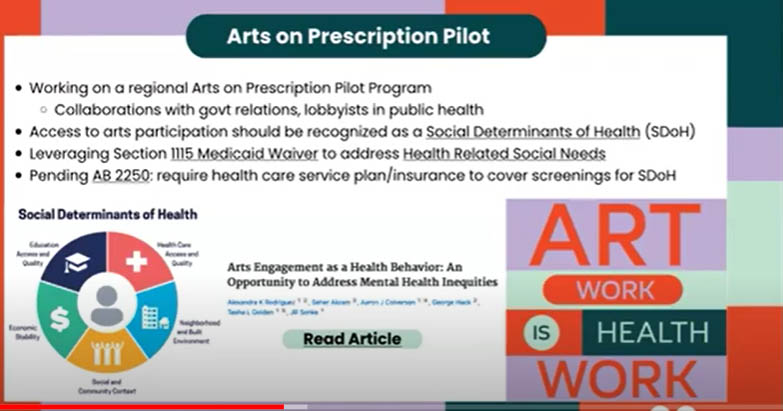
health one of the 7 priorities of the organization. In 2024, introducing AB2250
to get insurance to pay for screening of art as a social determinant of health.
Steps for advocacy:
Plan your campaign
Create Awareness
Generate Engagement
Encourage Action
Sustain Momentum
So one last suggestion for everyone reading this: Start to talk up Art Prescriptions so we create a buzz on this subject.
Of course, it is best for you to watch the sessions for yourself. Here are the videos below: